What Does a Country House PhD by Practice Look Like?
Sarah Capel is an artist-historian who completed her BA and MA in History at the University of Warwick over twenty years ago and returned to academia to pursue a practice-based PhD at Coventry University in 2021. Her research case study was based at the National Trust property, Oxburgh Hall in Norfolk.
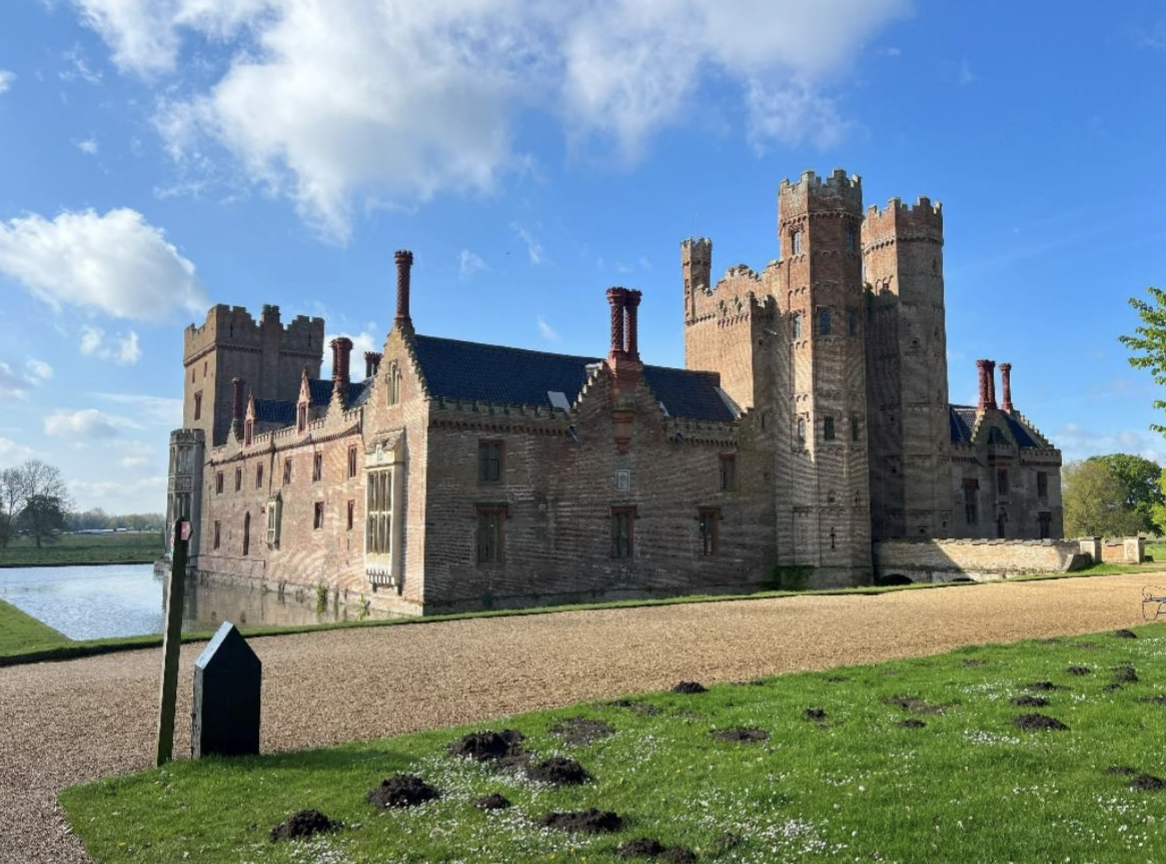
This week I received my PhD certificate so it seemed the perfect time to reflect on the past five years in the form of a blog post for the PGECR Country House Group. While I’m feeling somewhat bereft having completed my PhD, it’s lovely to indulge in a selection of memories and experiences that capture the essence of my practice and research.
Having worked as an artist and creative workshop facilitator in the community in the years running up to my PhD, I initially planned to explore historic examples of women working collaboratively in their creative lives, and relate this to contemporary art and craft. Early in 2022, I was planning a research trip to see The Oxburgh Hangings (embroideries made by Mary Queen of Scots and Elizabeth Talbot, Countess of Shrewsbury) which are on loan to Oxburgh Hall from the Victoria and Albert Museum (V&A). Through the National Trust’s website, I learned that the Hangings had been relocated back to the V&A while a major roof restoration project was underway. The website shared excitedly that during the Covid-19 lockdown in 2020, an archaeologist working alone in the attic rooms had uncovered thousands of rare items under the floorboards. Highlights included a medieval manuscript; tiny fragments of music written using a style called ‘mensural notation’ common to the late fifteenth and early sixteenth centuries; and a rats’ nest containing high value Tudor textiles.
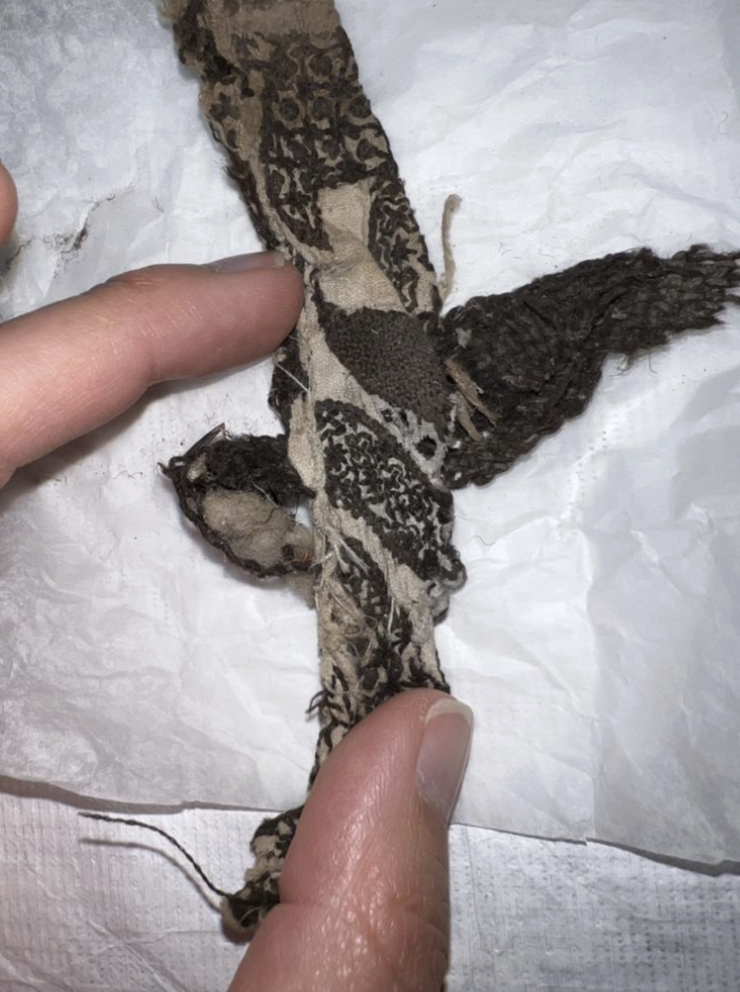
‘Raise the Roof’ underfloor find, blackwork embroidery on linen (NWWNR\T26-27 363, CMS no.1211849), The National Trust, Oxburgh Hall.
In September 2022, I spent time in one of the attic rooms looking through boxes of the recovered material. I was captivated by the story of rats collecting scraps of material for making a nest, and by the image of their underfloor home that was created over time. While I was simultaneously repulsed and fascinated by the rats’ collection, the fact remains that they unwittingly preserved fragments of exquisite sixteenth and seventeenth century textiles. I started thinking about how I could utilise my art practice, as well as my training as a historian, to interpret such a diverse collection of material fragments, and then to broaden that into an inquiry about the way people in the early modern period understood time, space and memory.
The result of my research is a new body of artwork entitled Fugitive Pieces (2021-ongoing), that demonstrates that the act of creating art can itself be a form of historical inquiry. By bringing historic and contemporary fragments into conversation with one another, I explored how materials carry memories within them and how these can be unlocked through artistic practice. This isn't just a theoretical argument. It plays out in the studio, in the archive, and in the gallery, where participatory exhibitions create communities that stretch across the centuries.
During the latter stages of my research, I was keen to test these theories and see how useful they might be to visitors to Oxburgh Hall coming to see the various fragments on display. I got the chance to show my artwork and talk about my research with Oxburgh Hall volunteers in April 2024. Alongside an exhibition of my artwork was a day of workshops for volunteers which included looking at a selection of the original attic artefacts - including a fragment of blackwork embroidery - and some practical, creative activities.
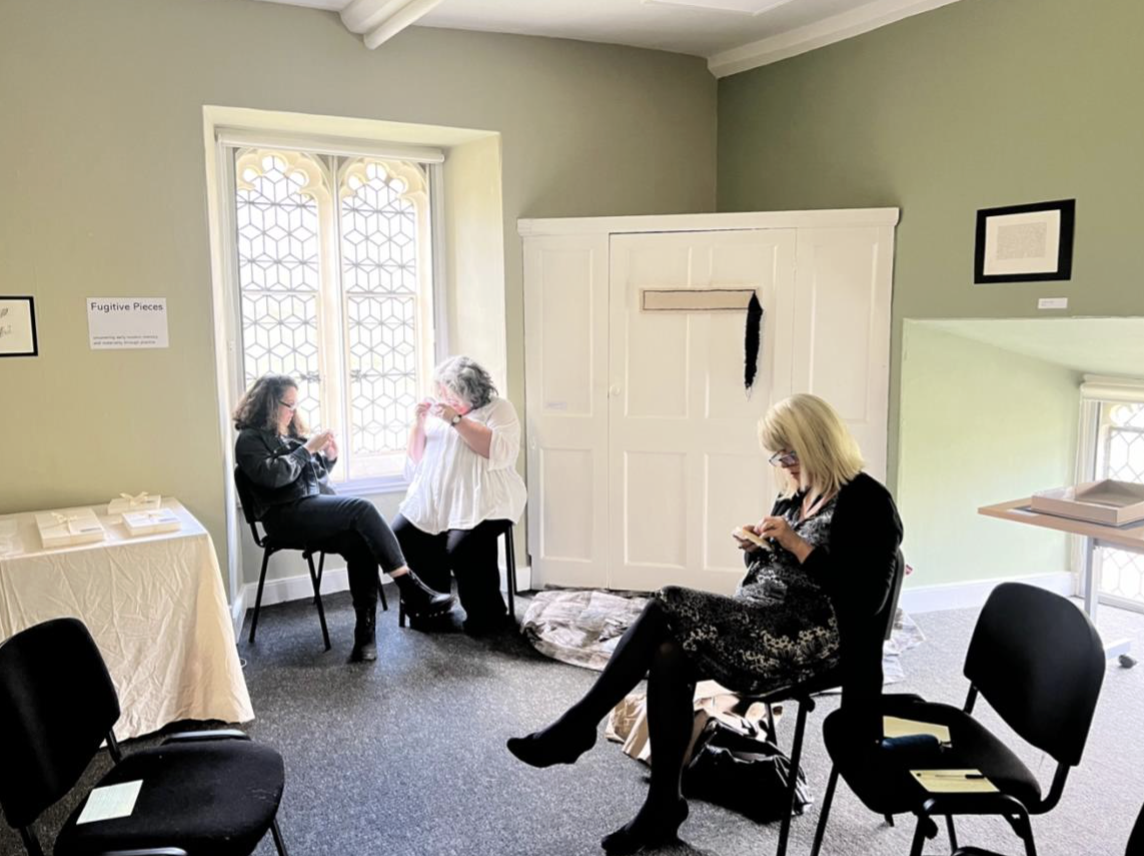
Documentation of workshops at Oxburgh Hall 29 April 2024.
Participants attempted blackwork embroidery in the same low-light conditions as the attic space across the courtyard. The counted thread method of blackwork embroidery involves counting the holes in tightly woven linen in order to build a pattern stitch by stitch. It is painstaking and requires a lot of patience as well as good eyesight! Attempting this activity in similar conditions to those in which the found fragments had originally been made was particularly effective at translating theoretical knowledge about historic embroidery into an embodied experience. Participants reflected on how it enhanced their appreciation of the skill, dexterity, and endurance required for early modern needlework, transforming abstract ideas about labour, materiality, and time into felt, sensory insights. As we sat and stitched, we chatted about whether people might have taken their sewing out into the garden to benefit from a more even light, and how stitching can become strong tacit knowledge that could have compensated for deteriorating eyesight.
The workshops and exhibition were generously supported by a research grant from The Pasold Research Fund. The impact of the exhibition and accompanying workshops on the volunteers at Oxburgh Hall turned out to be one of the most meaningful outcomes of the project. Almost all of those who took part said they intended to draw on what they had learned when interacting with visitors in the future - a sign that the workshops opened new ways of thinking about how to interpret the property's history. This kind of embodied engagement with historic practice has real potential beyond my PhD project and suggests a model worth exploring at other heritage sites.
For more information about Sarah’s work, visit sarahcapel.com